


Partnerships are purposive strategic relationships between independent firms who share compatible goals, strive for mutual benefit, and acknowledge a high level of mutual interdependence. They join efforts to achieve goals that each firm, acting alone, could not attain easily (Mohr and Spekman, 1994). Partnership is a dynamic relationship among diverse actors, based on mutually agreed objectives, pursued through a shared understanding of the most rational division of labour based on the respective comparative advantages of each partner. Partnership encompasses mutual influence, with a careful balance between synergy and respective autonomy, which incorporates mutual respect, equal participation in decision-making, mutual accountability, and transparency (Brinkerhoff, 2002). Partnerships are purposive strategic relationships between independent firms who share compatible goals, strive for mutual benefit, and acknowledge a high level of mutual interdependence. They join efforts to achieve goals that each firm, acting alone, could not attain easily (Mohr and Spekman, 1994).
Partnership is a dynamic relationship among diverse actors, based on mutually agreed objectives, pursued through a shared understanding of the most rational division of labour based on the respective comparative advantages of each partner. Partnership encompasses mutual influence, with a careful balance between synergy and respective autonomy, which incorporates mutual respect, equal participation in decision-making, mutual accountability, and transparency (Brinkerhoff, 2002).
References
Brinkerhoff, J.M. (2002). Assessing and improving partnership relationships and outcomes: a proposed framework, Evaluation and Program Planning, Vol. 25, No. 3, pp. 215-231.
Ellram, L.M. and Hendrick, T.E. (1995). Partnering characteristics: a dyadic perspective, Journal of Business Logistics, Vol. 16, No. 1, pp. 41-64.
Mohr, J. and Spekman, R. (1994). Characteristics of partnership success: partnership attributes, communication behavior, and conflict resolution techniques, Strategic Management Journal, Vol. 15, No. 2, pp. 135-152.
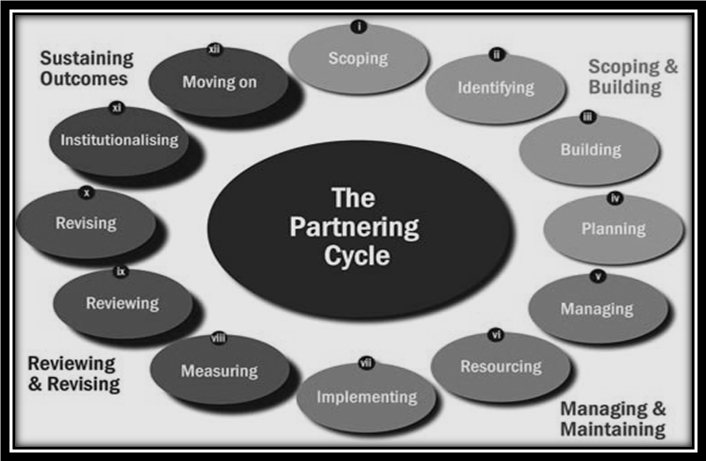
Source: Thepartneringinitiative.org
According to Thepartneringinitiative.org, a schematic; partnerships are evolutionary in nature and no one partnership conforms precisely to this sequence, but many have found it invaluable as a framework for their partnering work.
The essential requirements for partnering
- Management commitment – Commitment from top-level management to ensure focus on success of relationship.
- Trust – Mutual respect and trust between the parties.
- Sharing – Openness and sharing responsibility for the success/failure of the relationship.
- Customer focus – There must be overall customer focus in the combined objectives.
- Innovation – Responsibility for encouraging and supporting innovation.
- Investment – Partnering is resource intensive and involves time and patience.
The core principles that are very fundamental to the effective working of sustainable development of partnerships – no matter where in the world, at what level or scale and/or with what partners they operate are (Thepartneringinitiative.org):
- Equity: What does ‘equity’ mean in a relationship where there are wide divergences in power, resources and influence? Equity is not the same as ‘equality’. Equity implies an equal right to be at the table and a validation of those contributions that are not measurable simply in terms of cash value or public profile.
- Transparency: Openness and honesty in working relationships are pre-conditions of trust – seen by many as an important ingredient of successful partnership. Only with transparent working will a partnership be truly accountable to its partners’ donors and other stakeholders.
- Mutual benefit: If all partners are expected to contribute to the partnership they should also be entitled to benefit from the partnership. A healthy partnership will work towards achieving specific benefits for each partner over and above the common benefits to all partners. Only in this way will the partnership ensure the continuing commitment of partners and therefore be sustainable.
These three key principles can be a useful starting point for discussion between potential partners prior to formalising the partnership, even if they are subsequently replaced by different principles developed by the group. What is important is that all partners accept and agree to abide by whatever the group itself decides is appropriate (Thepartneringinitiative.org,).
Features of a successful partnering
Thepartneringinitiative.org stated that it is important that partnership means something specific and can be differentiated from other forms of cross-sector engagement and collaboration. Above all, it is important that the partners themselves in any partnership work through; agree and document a shared definition of their understanding of their partner relationship. It therefore follows that any successful partnering must possess the following essential features:
- First, it must first be a voluntary effort.
- Second, all participants must be willing to embrace the concept.
- Third, successful partnering must be focused on the communication of needs, strengths and expectations of each party at appropriately specified milestones during the performance of the required activity. Therefore, a “partnering process” must be mutually developed and followed.
- Fourth, goals must be established so that the degree of success of the partnering effort can be measured throughout the performance period.
Business partnering is “the development of successful, long term, strategic relationships between customers and suppliers, based on achieving best practice and sustainable competitive advantage” (Lendrum, 1997). The mission of business partnering consists in “creating, organising, developing and enforcing operative (short-term), tactical (medium-term) and strategic (long-term) partnerships” (Droli, 2007).
Benefits of business partnering
- Reduction of general costs. Business partnering can be cheaper and more flexible than a merger or acquisition, and can be employed when a merger or acquisition is not feasible.
- Business partnering increases the ‘competitive advantage’ (Porter, 1985). The direct benefits of Business partnering consists in a greater competitive advantage through the co-operation (the competitive advantage) and even better opportunities of revenues, occupation and investment in the sector of application.
- Business partnering creates a no more traditionally-based solidarity or “organic”, but a rationale form of “mechanic solidarity” (Durkheim, 1893). Partnering takes a new approach to achieving business objectives. It replaces the traditional customer-supplier model with a collaborative approach to achieving a shared objective; this may be to improve an existing service contract or launch an entirely new programme of work. Essentially, the Partners work together to achieve an agreed common aim whilst each participant may still retain different reasons for achieving that common aim.
- Partnering requires all partners to transform their businesses in terms of relationships, behaviours, processes, communications and leadership. Neither participant can succeed without the other so the recommended approach is to implement the transformation as a joint activity wherever possible.
- Business partnering is “a medium for achieving significant revenue growth” (Doz, Hamel, 1998)
Apart from the above, other benefits of partnering are as follows:
- Ability to stay focused on core competence
- Access to expertise, facilities and technology
- Avoid need to reinvent what has been invented elsewhere
- Better predictability of time and cost
- Better understanding between partners and driving down of real costs
- Better value for the client.
- Creation of an environment that encourages innovation and technical development
- Design integration with specialists in the supply chain
- Duplication eliminated
- Encourages innovation in design, service delivery and technology.
- Improved ‘buildability’ through early involvement of the contractors
- Improved service delivery through trust and openness and by working together looking to achieve continuous improvement.
- Improved understanding of the other party’s objectives, and achievement of combined objectives.
- Improving sustainability including local regeneration, environmental and ethical issues.
- Increased customer satisfaction
- Recognition and protection of profit margin for contractors and suppliers
- Shorter overall delivery period
- Speed and Flexibility in Delivering New Products
- Stability which provides more confidence for better planning and investment in staff and resources.
- Staff development and satisfaction
- Streamlining and making the supply-chain effective, including possible shared services, e.g. sharing of supply chains.
- Strengthened relationships with key suppliers or customers
- The shoring up of weak areas in the company
- Using Small and Medium sized Enterprises (SMEs) where appropriate, to enhance supply chain performance.
Disadvantages of partnering and alliances
- Sharing of future profits
- Foreclosure of other opportunities
- Barriers to future financing opportunities
- Distractions
- Creating a competitor or a potential competitor
- Unexpected disappointments
References
Allan Lowe and Associates Inc. (2011). Partnering. Retrieved on February 12, 2011 from http://www.allanlowe.com/
Child, J. & Faulkner, D. (1998). Strategies of co-operation: Managing alliances, networks and joint ventures. Oxford University Press. pp. 386.
Constructing Excellence (2004).Partnering. Retrieved on February 12, 2011 from Retrieved on February 12, 2011 from www.constructingexcellence.org.uk
Darby, M. (2006). Alliance brand: Fulfilling the promise of partnering. Wiley.
Doz, Y. L. & Hamel, G. (1998). Alliance advantage. The art of creating value through partnering, Boston: Harvard Business School Press.
Droli, M. (2007). Partnering turistico. L’Impostazione, la Creazione, l’Organizzazione ed il Rinforzo Continuo di una Partnership Strategica di Successo, Forum, Università degli Studi di Udine, Udine.
Durkheim (1893). The division of labour in society. The Free Press reprint 1997.
Gathering Pace Consulting (n.d.). Construction partnering guidelines: what is partnering? Partnering content, applications and results excerpted from William Ronco and Jean Ronco, Partnering manual for design and construction. (NY: McGraw-Hill, 1996).
Lendrum, T. (1997). The strategic partnering handbook: A practice guide for managers, McGraw-Hill, Nook Company.
Porter, M. (1985). Competitive advantage: Creating and sustaining superior performance, NY: Free Press.
Rigsbee (Ed, 1994). The art of partnering. Kendall/Hunt.
Wikipedia on Answers.com Business partnering on Answers.com. Wikipedia Copyright © 2011 by Wikipedia. Published by Wikipedia.
Williamson, O. (1975). Markets and hierarchies: Analysis and antitrust implications, NY: Free Press.
Principles of partnering and checklist. http://www.hounslow.gov.uk/partnering_principles_checklist.pdf
Muller, F. & Coughlin, R.A. (n.d.). What is partnering? http://adrr.com/adr2/Mmsart2.htm
Partnership – a definition. http://thepartneringinitiative.org/what_is_partnering.jsp
International Business Leaders Forum (2008).
Thepartneringinitiative.org. The strength of differences. http://www.thepartneringinitiative.org/what_is_partnering/Benefits_%26_Risks.jsp
Thinking about Facilities Management’ (The Business Round Table, 1996).
Partnering for Success. http://www.mvk.usace.army.mil/offices/cd/main.php?page=Partnering
Business partnering. (n.d.). Wikipedia. Retrieved February 16, 2011, from Answers.com Web site: http://www.answers.com/topic/business-partnering
Ellram, L.M. and Hendrick, T.E. (1995). Partnering characteristics: a dyadic perspective, Journal of Business Logistics, Vol. 16, No. 1, pp. 41-64.

