


The term ‘value’ relates to the benefits brought by something in relation to the resources needed to achieve it. The concept of Value in VM is based on the relationship between satisfying needs and expectations and the resources required to achieve them. By value is meant the value provided to customers, not the value extracted from customers or shareholder value. Value management is a holistic discipline that supports the cycle of Create → Communicate → Capture → Assess Customer Value, all based on a foundation of Understanding.

The Value Management Cycle (Haughey, 2017)
In value management, the term ‘value’ is understood as follows:
- Value is relative to an alternative – value cannot be judged in isolation.
- Value is composite and decomposable – value can be analysed into a set of value drivers.
- There is more than one aspect of value – in business-to-business (B2B), the most important aspect is the economic, but other aspects such as the emotional, environmental and social value can also be considered.
- Value can be quantified – economic value can be quantified in a currency, other aspects have their own forms of quantification.
On the other hand, VM is defined as the application of value analysis (value engineering) techniques for improvement of business effectiveness and efficiency (Business dictionary.com, 2017). Value Management (VM) is a technique concerned with defining, maximising and achieving ‘value for money’ (VfM). VM is a combination of planning tools and methods to find the optimum balance of project benefits in relation to project costs and risks. It is the process of planning, assessing and developing the project in order to make the right decisions about the optimised balance of the benefits, risks and costs.
The aim of VM is to reconcile all stakeholders’ views and to achieve the best balance between satisfied needs and resources. VM is concerned with improving and sustaining a desirable balance between the wants and needs of stakeholders and the resources needed to satisfy them. Stakeholder value judgements vary, and VM reconciles differing priorities to deliver best value for all stakeholders.
Relationships and organisations exist because of the value they offer other parties. This value must be optimised by sound ‘management’ practices if there is no value or not sufficient value relationships and organisations will not last (Definitions.net, 2017). Management is often included as a factor of production along with machines, materials and money. According to the management guru Peter Drucker (1909-2005), the basic task of management includes both marketing and innovation. Management consists of the interlocking functions of creating corporate policy and organising, planning, controlling, and directing an organisation’s resources in order to achieve the objectives of that policy.
VM is based on principles of defining and adding measurable value, focusing on objectives before solutions, and concentrating on function to enhance innovation. It uniquely combines within an integrated framework a value focused management style; a positive approach to individual and team motivation; an awareness of the organisational environment; and the effective use of proven methods and tools.
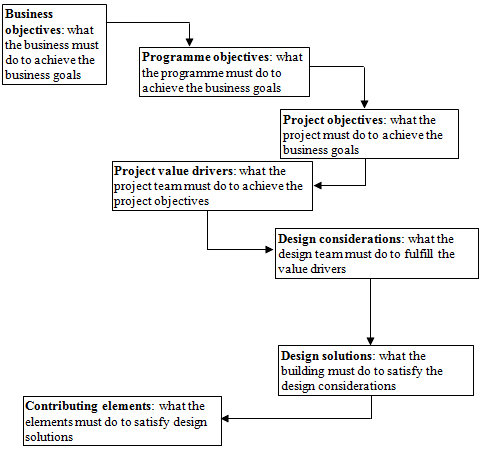
VM focuses on the expected outcome of a project. Only once the outcome is clearly established, understood, agreed and defined, does the process address the question of how it will be delivered. The outcomes are represented in a statement of project objectives, expressed in terms of the expected benefits to the business. These are linked through ‘value drivers’ (defined as a functional attribute that is necessary to fully deliver the expected benefits from a project – equivalent to a primary function) to the design intent. Later, as the project evolves, these relate directly to the design solutions and what is built.
VM Process
In the broadest sense, VM can be defined as a process of delivering some benefit to a client. When we talk about project implementation, delivery of expected results and organisation of activities, VM concerns the benefits that are derived by the customer from the successful implementation of a given project. When the project brings some value, it is worth implementing and can be qualified in business terms.
VM is a team-based approach used to define the client’s objectives and ensure best, whole-life solutions are selected to satisfy those objectives. It is not necessarily about cost cutting. To achieve maximum benefit, VM should be carried out from the very early stages of a project, not simply introduced when problems occur. The process of management includes value engineering, which is a more systematic approach to ensuring specific functions are satisfied to the required standard for the least cost. It assesses a range of possible solutions against the values required by the client.
One of the key principles of the VM process is that it focuses on achieving successful outcomes rather than on the process of getting there. Functional analysis provides a very powerful tool to identify intended outcomes. In developing a functional model, the team is forced to make a very clear definition of the project by considering key questions such as:
- What are we trying to achieve?
- What must we get right if we are trying to achieve it?
- What considerations do we need to bear in mind while designing it?
- How do various design solutions contribute towards achieving the desired outcome?
VM exercises can also be used to recover cost divergence (costs diverging from the budget) that may become apparent when design reports are prepared. Under these circumstances, the client may have to choose priorities, or decide to increase the budget. It may be possible to:
- Identify items that can be omitted.
- Identify items that can have theirspecification
- Identify items that could be re-instigated later in the programme if thebudget
- Identifyenabling works that can be incorporated into the design, allowing elements to be added during later phases of construction.
VM Techniques
VM techniques are commonly used in construction projects to serve two contextual situations; to achieve resource savings when a project has potentially crossed its limiting values in terms of cost or time, or to create an interface platform between the project commissioning team and the project delivery team to facilitate the development of a project delivery plan. VM techniques are primarily founded on three principal themes:
- Achievement of tasks through involvement and team work, based on the premise that a team will almost always perform better than an individual;
- Using subjective judgement, which may or may not incorporaterisk assessment; and,
- Valueis a function of whole life cost and utility in its broadest sense.
The key decisions in the application of VM on projects relate to:
- When should it be used?
- Who should be involved?
- Who should perform the role of the facilitator?
A balance must be struck between early application before an adequate understanding of the problem and constraints, and late application, when conclusions have been drawn and opinions hardened. Feasibility (when identifying suitable options) and pre-construction (before the design freeze) would generally be suitable, but each project should be examined on its merits.
There are a number of techniques, which are commonly used in the conduct of VM studies. Some of these techniques are:
- Valuedrivers
- Function analysis.
- Function analysis system technique (FAST).
- Cost/worth.
- Valuebenchmarking (or value profiling).
- Options selection.
- Weighting techniques.
- Creative techniques.
- Evaluation techniques.
- Scenarios technique.
- Target costing.
- Functionperformance specification (FPS).
Value Driven Management
Multiple methods and approaches for managing value pursue one and the same set of goals, including the following:
- To achieve a better understanding of business needs of the performing organisation
- To set simple and clear definition of specific stakeholder needs
- To consider all options, alternatives and innovative ideas regarding project implementation and product delivery
- To achieve optimum value for money while satisfying the range of customer requirements
- To minimize the likelihood of unnecessary expenditure by reducing waste and inefficiency
- To improve collaboration and communication with customers.
Once the main key drivers have been identified, management should focus on developing a plan to change the parameters of these drivers and creating a permanent mechanism that links them to daily activities in one hand and value on the other. This is the essence of Value Driven Management. The following are the steps management teams can follow to implement Value Driven Management in their organisations:
- Select those key value drivers the organisation is going to focus going forward.
- Determine the exact and correct parameter that needs to be measured for each of the key value drivers, as well as its current value.
- Establish what is the desired direction of change and if possible a specific target value for each value driver.
- Define the actions that need to be taken todayin order to achieve the target.
- Assign clear responsibilities for each of the actions defined above.
- Design a compensation or incentive mechanism to reward people for achieving established targets.
- Build a monitoring system to keep track of progress.
- Review the validity of key value drivers as often as necessary but especially if and when targets have been achieved.
- Ensure all three value driver categories are included in the process at all times.
- Measure the value created by those drivers where targets have been achieved
Benefits of Value Management
Value management (MV) delivers profitable growth. It does so through the following ways:
- Innovation is focused on products and services that provide value to the customer (innovation that does not provide additional value relative to the best alternatives is money that is thrown away)
- Markets are segmented and pricing architecture structured around how the customer gets value (this helps to maximize prices across the full range of potential customers)
- Value is communicated in marketing messages (so that messages can rise above the noise of generalized claims)
- Prices are based on how and how much value customers get from your solution ( helping to manage discounting and commoditization pressure)
- Sales negotiations are shifted from demands about price to tradeoffs on value (controlling discounting and managing costs)
The primary benefits of a VM exercise are:
- A clear definition of what the owners and end users mean byvalue, thus providing a precise basis for making decisions throughout the project.
- A tool for optimising the balance between differingstakeholder needs and expectations.
- A basis for creating a clearproject brief that reflects the project sponsor’s priorities and expectations, expressed on the basis of value and function. This improves communication between all the stakeholders so that each can understand and respect the other’sconstraints, expectations and requirements.
- A basis for ensuring the project is the most effective way of delivering business benefits and satisfying business needs.
- A functional basis for embellishing and refining thebusiness case for the project, by addressing both the monetary and non-monetary benefits.
- A functional basis fordesign development and management, through improved communications, mutual learning and enhanced collaborative working, leading to better technical solutions with enhanced performance and quality, often through innovative solutions.
- A functional mechanism to measurevalue, taking into account monetary and non-monetary benefits and thus demonstrating value for money.
Generally, the participants in a VM process are selected on the basis of their technical or managerial expertise, rather than their skills in contributing to a collaborative effort. Difficulties can arise for many reasons; organisational, technical, personal or even due to the process itself. Some of the potential difficulties are include:
- A lack of belief in the process;
- Difficult people with difficult personality traits;
- Members of the team representing different organisations may be working to different agendas which are not aligned to those of thevalue management process;
- Conflicts between individuals and a tendency to point scoring;
- Lack of effective communication leading to misunderstanding;
- Differing objectives for individuals and organisations;
- Blame culture;
- Attitudinal issues;
- Differing and perhaps unrealistic expectations; and,
- Individual insecurity – needing to make their mark.
References
Businessdictionary.com (2017). Definitions of management. http://www.businessdictionary.com/ definition/management.html
Businessdictionary.com (2017). Value-drivers. http://www.businessdictionary.com/definition/value-drivers.html
Definitions.net. (2017). Definition of VM. (n.d.). Retrieved on August 3, 2017 from http://www.definitions.net/definition/VM.
Designingbuildings.co.uk (2017). Value in building design and construction. https://www.designingbuildings.co.uk/wiki/Value_in_building_design_and_construction
Designingbuildings.co.uk (2017). Overcoming difficulties in construction value management. https://www.designingbuildings.co.uk/wiki/Overcoming_difficulties_in_construction_value_management
Designingbuildings.co.uk (2017). VM techniques for building design and construction. https://www.designingbuildings.co.uk/wiki/Value_management_techniques_for_building_design_and_construction
Hamersley, H (2002). VM in Construction, Dallas.
Haughey, D. (2017). Smart goals. https://www.projectsmart.co.uk/smart-goals.php
Identifying and Managing Key Value Drivers. Volume I, Issue 1. http://www.lek.com/sites/default/ files/Volume_I_Issue_1.pdf
Krogger &Co (2016). Key value drivers. http://www.krogger.co/key-value-drivers.html
Linman, D. (2010). VM in projects – definition and goals. http://www.mymanagementguide.com/value-management-in-projects-definition-and-goals/
Stabler, R. (2017). Master ten value drivers to sell your business at the highest price. https://www.divestopedia.com/2/1041/maximize-value/company-premium/master-ten-value-drivers-to-sell-your-business-at-the-highest-price
The Institute of VM (2017). What is value? Retrieved on August 3, 2017 from https://ivm.org.uk/what-is-value-managementRet
Value Management Advocates (2012). What is VM? (And why you should care). A position paper from an open group of VM practitioners and consultants. http://customervaluefoundation.com/What%20is% 20Value%20Management%20V1%2011082012.pdf
Web Finance Inc. (2017). Definition of VM. rieved on August 3, 2017 from http://www.businessdictionary.com/definition/value-management.html
Web Finance Inc. (2017). Definitions of management. Retrieved on August 3, 2017 from http://www.businessdictionary.com/definition/management.html

